When the Product Owner becomes a mailbox
A Scrum Master’s reflection on ownership without authority, management overload and a culture that pushes its unresolved problems into the code.
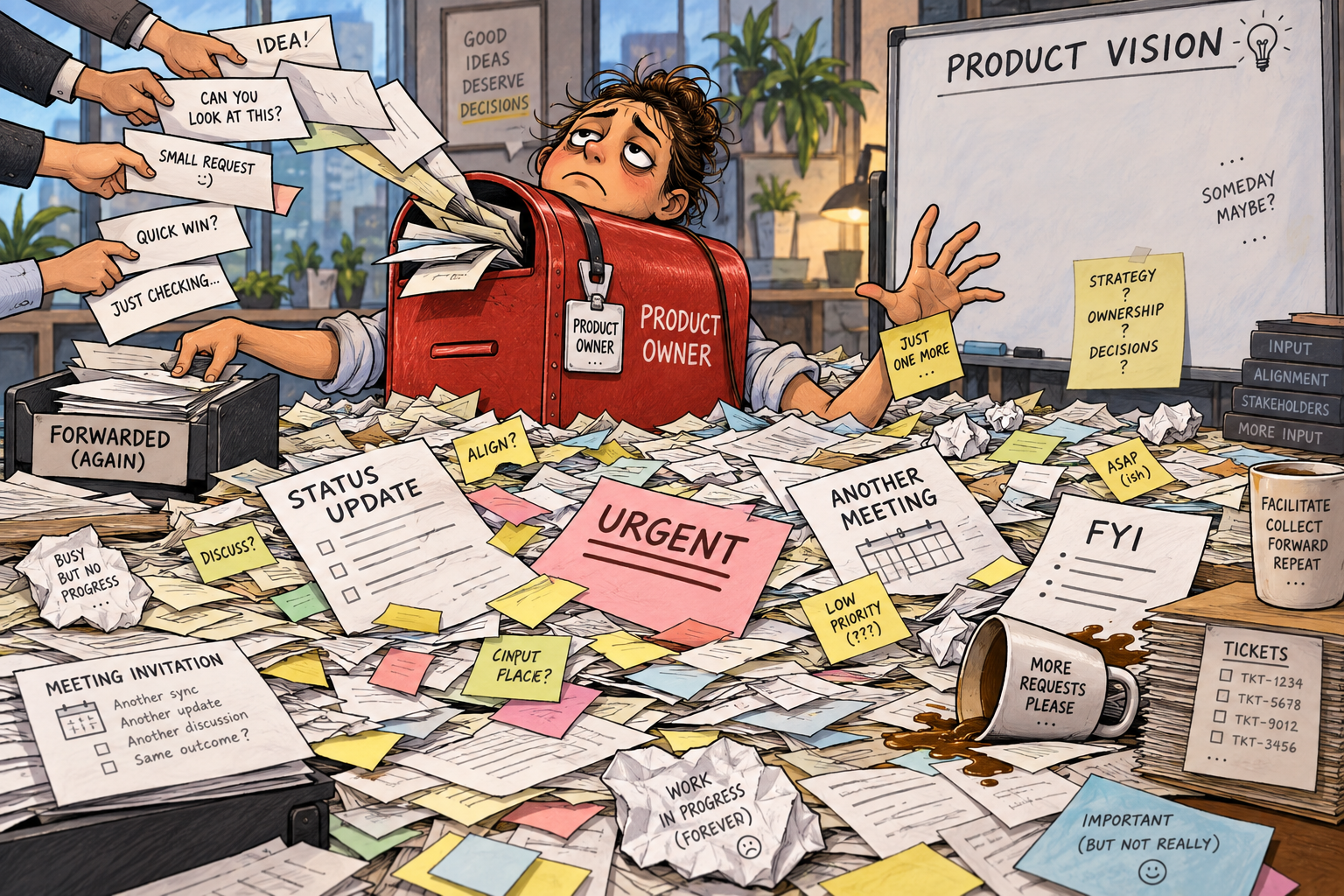
There is a version of product ownership that looks convincing from a distance. A backlog exists. Tickets have acceptance criteria. Someone attends stakeholder meetings and brings work back to the team. The role has a name, a calendar and a Jira account.
What it lacks is permission to decide.
I recognise this from a project where I worked as a Scrum Master. The Product Owner role had become a mailbox for requests and a mechanism for moving tickets. Around a single product or service, too many people could influence the work, while responsibility for its consequences remained unclear.
That experience changed what I look for when I join a team. Before asking how well the backlog is maintained, I want to know who can actually make a product decision and have it respected.
The backlog becomes a queue of other people’s promises
A Product Owner needs to listen to stakeholders. The problem begins when listening creates an obligation to accept every request, and prioritisation becomes an exercise in finding space for promises made elsewhere.
Under those conditions, a beautifully organised backlog can still be a wish list. The person maintaining it can explain what has been requested, but cannot resolve competing demands or decide what should wait.
Jira makes the work visible. It cannot supply the missing authority. Calling someone a ticket pusher may describe the situation, but it unfairly puts the failure on the person carrying it.
The Scrum Guide connects product ownership with responsibility for value and makes organisational respect for the Product Owner’s decisions essential. Assigning the responsibility while withholding the authority leaves a gap that no amount of refinement can close.
A person cannot own the outcome if every meaningful decision belongs to someone else.
Too much management, too little resolution
Management has useful work to do: provide direction, secure resources, clarify constraints and resolve conflicts that a team cannot resolve alone. The trouble starts when several layers oversee the same product without clear boundaries between their decisions.
Each layer can add a request, demand an update or reopen an agreement. Yet a decision to stop work, reduce scope or fund maintenance may still have no clear owner.
That creates waste long before anybody writes code. People prepare different versions of the same status report. Priorities return for another round of alignment. Developers pause to explain work they have already explained. The Product Owner becomes the translator between competing expectations.
The question I take from my experience is simple: does this management activity help the team make a decision, or does it create another audience for the same unresolved problem?
When the problem becomes the person raising it
The cultural side is harder to confront. A lack of authority is damaging enough. It becomes more destructive when leadership denies the constraints while continuing to hold people responsible for their effects.
I use gaslighting carefully here. Disagreement, an unpopular decision or a mistaken recollection does not automatically qualify. The pattern I am concerned with is repeated denial or rewriting of events that undermines people’s confidence in what they experienced.
For example, a team might be overruled on scope and later blamed for accepting too much. A technical risk might be dismissed, then treated as something nobody raised. A Product Owner might be encouraged to take ownership, only to have a decision reversed and their confidence questioned. These are examples of the pattern, rather than quotations from a particular meeting.
When that happens repeatedly, honesty becomes costly. People may learn to soften warnings, keep concerns out of reports or remain silent. Leadership then receives a more reassuring picture while losing the information needed to make better decisions.
As a Scrum Master, I see that as a leadership problem with delivery consequences. A retrospective cannot repair it unless the people with authority are willing to examine their own behaviour.
The organisation’s compromises end up in the code
My technical background makes this part particularly difficult to ignore. Unresolved organisational problems can become engineering problems with a much longer life.
Consider a team pulled between competing deadlines. A narrow workaround gets a feature delivered. Tests or refactoring are deferred. A second request arrives before the first compromise can be revisited. Soon, another feature depends on that workaround, and removing it becomes more expensive.
Repeated across a product, that can mean duplicated logic, brittle integrations, missing tests and knowledge that lives with a single developer. The cost returns through incidents, slower changes and work spent understanding why the system behaves as it does.
Legacy software is not inherently bad, and poor leadership is not the only source of technical debt. But when management repeatedly rewards immediate output and postpones maintenance, it helps create the conditions for both. Blaming developers for the resulting code hides the decisions that shaped it.
Technical debt can outlive the management decision that made it seem reasonable.
What I would make explicit before the next Sprint
The mailbox metaphor points to a useful starting point: a Product Owner’s mandate needs to be discussed before the board becomes the centre of attention. I would turn that into four concrete conversations:
- Who has the final say on product priorities? Stakeholders need a route to influence decisions, and the Product Owner needs a mandate to resolve competing requests.
- What can the Product Owner decide independently? Make limits around budget, scope and risk explicit, with a clear path for decisions beyond those limits.
- Who supplies funding, expertise and capacity? Clarify how those contributions inform decisions without creating several competing owners of the product.
- What happens when stakeholders disagree? Name who resolves the conflict and how quickly, so the team does not have to absorb it as contradictory work.
Those agreements need to survive a difficult week. An urgent request should include a decision about what it displaces. A known risk should remain visible when its consequences arrive. Quality expectations need to be reflected in plans, rather than quietly sacrificed to protect a date.
What I take into my work now
My responsibility as a Scrum Master includes making these patterns discussable: separating observations from assumptions, showing the cost of interruptions and helping people clarify where decisions belong. A short record of an agreement can preserve shared understanding when memories diverge. It cannot substitute for leaders taking responsibility.
The lesson I carry from that project is that team development and leadership behaviour are inseparable. We cannot ask people to take ownership while making every meaningful choice for them, or demand transparency while punishing inconvenient information.
A better board may make the mailbox easier to manage. Giving the Product Owner a real mandate, supporting the team’s technical judgement and reducing conflicting control are what create room for actual product ownership.